The Fire Was Never Yours to Carry
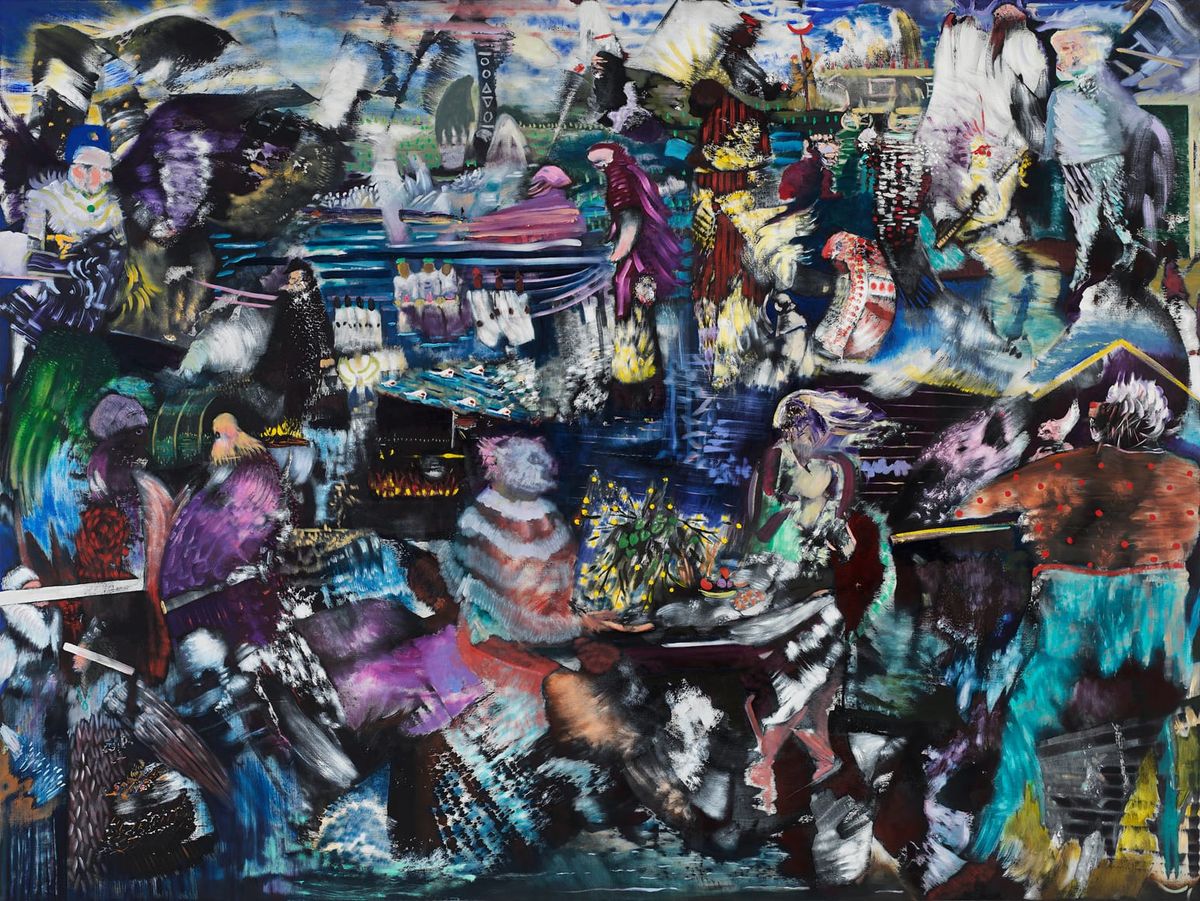
There are paintings you look at, and there are paintings that find you, that reach across whatever distance you thought you'd put between yourself and the thing you've been carrying, and demand that you stay.
I was standing in front of Ali Banisadr's Still Life when something shifted, not in the room itself, not in any observable or nameable way, but somewhere older than that, somewhere below the level of thought entirely, in the part of the body that keeps its own records and does not ask your permission before it responds. Chills first. Before any word had formed, before my brain had caught up with what my nervous system already knew, the recognition moved through me like a current, like something arriving home after a very long time away.
I stayed longer than I meant to.
To understand what Banisadr is doing in Still Life, you have to understand something about who he is and where he came from, because with him, the two things are inseparable in a way that isn't true of every artist. He was born in Tehran, and his early childhood was the eight-year Iran-Iraq war. He has synesthesia, the condition in which the senses arrive tangled, in which sound comes in wearing color, and as a child he drew what the bombing sounded like, because drawing was the only way to give the noise somewhere to go. That origin matters here, because it means that everything Banisadr has ever made is rooted in the problem of how you render internal chaos in a form that other people can see and feel. He is not painting what things look like. He is painting what they feel like from the inside, which is an entirely different and far more demanding project.
His paintings are layered the way memory is layered, autobiography pressed into mythology pressed into world history, none of the strata quite willing to stay separate. He knows the history of painting the way you know a house you grew up in, and you can watch him move through its rooms: the brushwork carries de Kooning's speed and appetite, and the mood has something of Bacon's interiors, that sense of a room where something has happened, or is about to. You can feel all of that in Still Life, the layering of references, the sense that you are looking at something that has absorbed the whole history of painting and then pressed it through the filter of a single, very specific human experience.
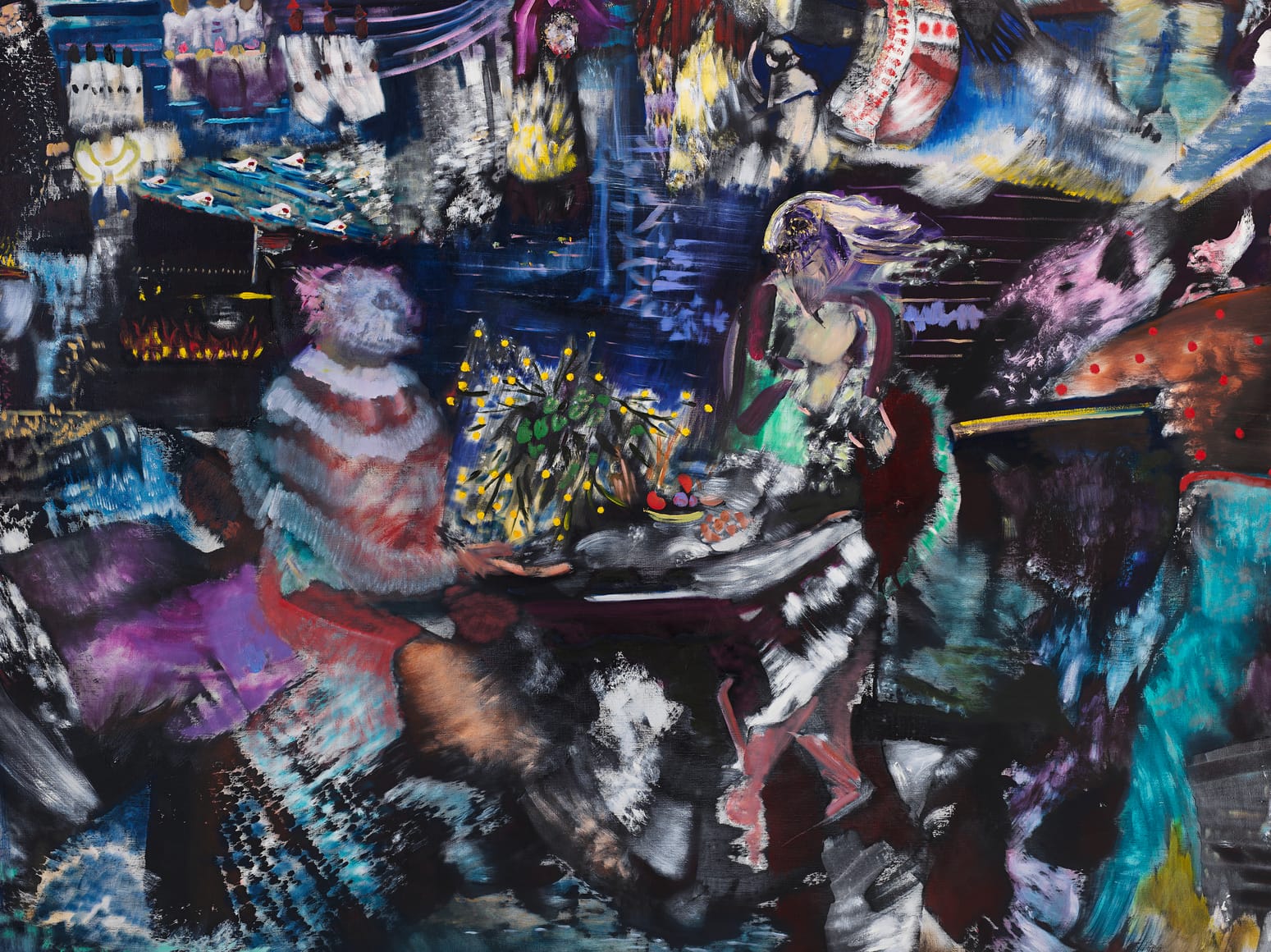
The painting is chaos and it is tender and it is, in the most literal sense, on fire. A table scene, figures draped in crimson and teal, a cat positioned at the center with the particular self-possession of something that has decided, without announcement, not to participate in the surrounding disorder. And behind all of it, a trunk burning. Not as backdrop, not as an accident, burning with the specific, patient intensity of something that has been burning for a long time, that was burning before anyone in the room arrived, that will keep burning long after everyone has gone.
I know that fire.
What Banisadr does with color here is something I kept returning to, kept turning over in my mind the way you turn over a sentence that hasn't finished giving itself to you yet. The crimson bleeding through the composition isn't decorative, it isn't atmosphere, it's alive, it's unresolved, it carries the particular heat of anger that has never quite found where to put itself, that has been passed hand to hand down a long line of people who didn't know how to set it down and so simply kept walking with it, kept handing it forward. The teal moving toward the back of the cloak feels like water, like something in the slow and effortful process of leaving the body, like healing that is happening whether or not you've decided to call it that yet.
This tension between disorder and composure, between the burning and the still center, is something that runs through the entire lineage Banisadr is working within. Critics reach for Hieronymus Bosch on one side and the Persian miniature tradition on the other, and both comparisons are right, but not in the way comparisons are usually right, not as resemblance. As inheritance. Bosch understood, five centuries before the language existed for it, that the domestic and the apocalyptic are not opposites but neighbors, that the everyday scene and the scene of total collapse occupy the same space and can tip into one another without warning. His triptychs are full of tables, of figures gathered around ordinary life, while everything around them burns or warps or becomes something monstrous. Still Life is in direct conversation with that tradition, that understanding that domesticity is never just domesticity, that the table is always also the place where the unspoken things gather.
Pieter Bruegel the Elder understood this too. His panoramic canvases are populated with the full chaos of human life, figures going about their business, celebrating, arguing, collapsing, all of it happening simultaneously in the same frame, and what makes them devastating is the sense that no one has any idea what is happening just over their shoulder. In Still Life, that Bruegel influence shows up in the layering of activity, the sense that you could keep looking and keep finding things, that the painting has more in it than you can take in at once.
And then there is Anselm Kiefer, who spent decades making art from the problem of inherited guilt and scorched earth, enormous canvases of ash and lead and straw that asked what you do with a history you didn't choose but were born into and cannot put down. Kiefer's work is about the weight of what gets passed forward, the landscape that remains after the fire, and the question of whether you can grow anything in it. The burning trunk in Still Life carries something of that same energy, that same unflinching willingness to look directly at the fire rather than away from it.
And then my eyes went back to that trunk.
Because I have been thinking, for some time now, about the things we carry that were never ours to begin with, the patterns so early and so completely absorbed that they settled into what felt like personality, like identity, like simply the way things are and have always been. The fire that you stoke not because you chose it but because you were shown it, because to stop stoking it felt like abandonment, like betrayal, like walking away from something that had been declared sacred by people you loved before you were old enough to question the declaration. You were the next one in line. The trunk was already burning when you got there.
My body has been the record keeper of all of it, loyal and exhausted in equal measure, holding the ledger long after my mind had decided, consciously and with great effort, to release what it was carrying. The body doesn't forget. It keeps its accounts with extraordinary faithfulness, and it will go on keeping them, at considerable cost, until you find a way to convince it that the debt was never yours to pay.
This is what Still Life understands about being human, about what it is to be a person who came from people who were also carrying things they didn't choose.
The cat at the center of the table doesn't march. It watches, it waits, it stays curious in the middle of everything burning around it, and I think that quality, that refusal to be consumed by the fire that is not its fire, is the thing the painting is actually asking of us. Not resolution, not the tidy extinguishing of everything that has come before, but curiosity. The willingness to keep looking even when looking costs something, to stay open when every learned instinct is telling you to close, to stand in front of a painting and let it surface what you've been carrying and then, with whatever grace you can manage, begin to set it down.
There is no winner in these paintings. The procession never resolves into order, the disorder never quite swallows the procession, and anyone who comes to them looking for serenity will leave without it, because serenity is not what they have to offer. What they offer is harder and better: the instruction to keep looking for the light inside the density, because the light is in there. It is always in there. The teal is moving. The water is always finding its way out.
There is a particular kind of relief in standing in front of a work of art and feeling, with your whole body and not just your mind, that you are not the only one who has ever felt this way, that the fire, the grief, the anger without a clear address, the slow and radical work of learning what is yours and what was handed to you, all of it has been felt before and carried before and rendered in paint before, by Bosch and Bruegel and Kiefer and now Banisadr, each of them insisting in their own way that the chaos is real and the burning is real and the tender center holding steady in the middle of all of it is real too. That you are not broken for feeling it. That you are, simply and irreducibly, human.
To release is to fly.
I wrote that line in my notebook that afternoon, sitting in front of the painting, not entirely sure yet what I meant by it. I think I know now. I stood in front of a still life that was anything but still, and felt something I had been carrying for a very long time begin to loosen its grip.
That is still life.
Sources & Further Reading
Ali Banisadr, Still Life (2024) alibanisadr.com/paintings/still-life
Ali Banisadr: The Alchemist, Katonah Museum of Art (2025) katonahmuseum.org
Ali Banisadr — Kasmin Gallery kasmingallery.com
Hieronymus Bosch, The Garden of Earthly Delights (c. 1490–1500) Museo Nacional del Prado, Madrid museo del prado
Pieter Bruegel the Elder — Britannica britannica.com
Anselm Kiefer — The Art Story theartstory.org